
Blog
Why Older Minnetonka Garages Fight the Cold
Minnetonka's housing stock dates mostly to 1957-2005, before today's insulation codes, leaving many garage doors uninsulated against severe cold winters here.
What Is Going On
Most of the houses around Minnetonka went up between 1957 and 2005, with the bulk of that stock landing in the 1960s and 70s. That matters more than it sounds like it should, because garage door insulation rules didn't exist yet when those doors went in. A single steel skin with no foam core, no thermal break, nothing behind the panel but air - that was a normal door then, not a cheap one. Across the 52 named areas that make up this service territory, the same basic door shows up house after house: original hardware, original panel, no insulation layer at all.
That's not a defect. It's just what the building code required at the time, which was nothing on this point. The problem shows up later, when a door built for a mild expectation has to hold the line against a real winter. The gap between the garage and the house starts to matter. A door that was fine for forty years starts costing you in heat loss, condensation on the inside face, and hardware that works harder than it was designed to. None of that means the door is broken. It means the door predates a standard that didn't exist when the house was framed.
What to Check
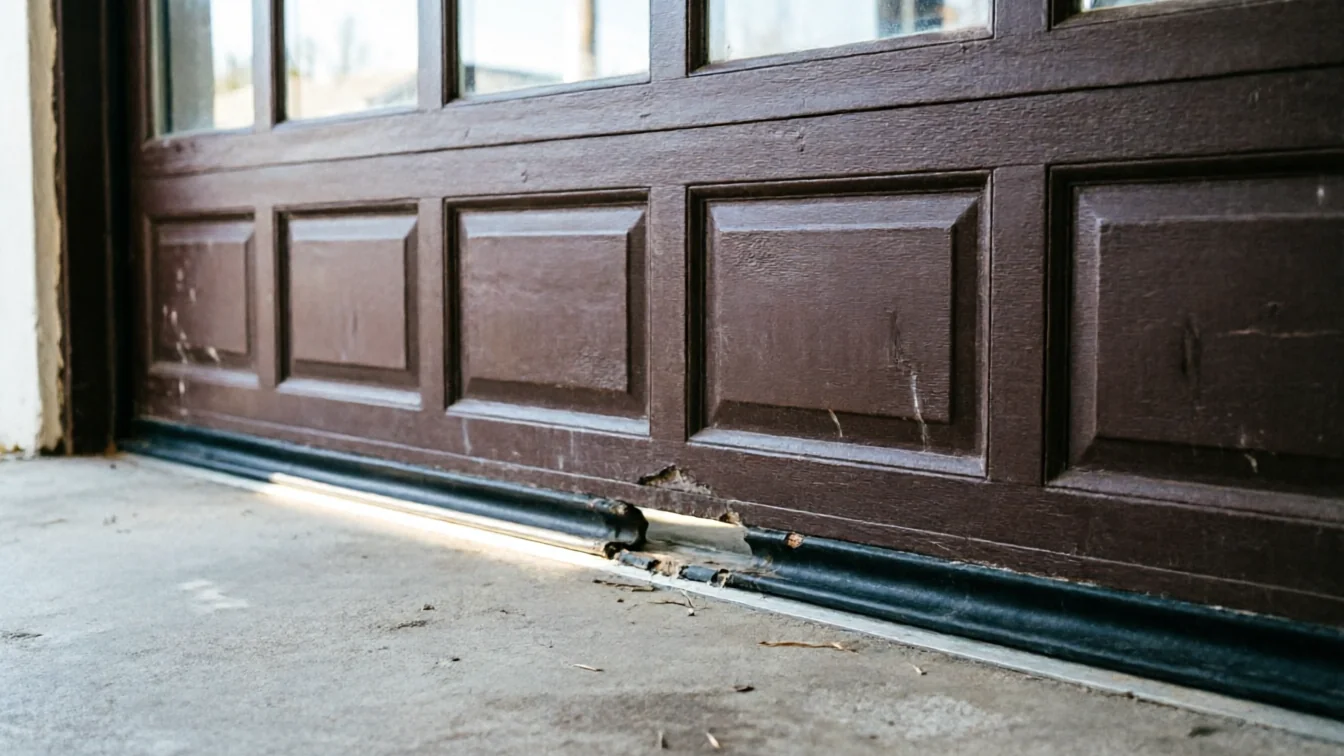
Start at the bottom seal. On a door this old, the rubber gasket along the floor has usually hardened, cracked, or pulled away from the track - look for daylight showing under the closed door on a sunny afternoon. Next, run a hand along the inside face of the panel on a cold day. If it's cold to the touch and slightly damp, there's no insulation layer doing any work, and condensation is forming on bare steel.
Check the weatherstripping around the jambs, not just the bottom. Original stripping from a 1960s or 70s install is usually thin, brittle vinyl, not the compressible bulb seal used now. Look at the panel seams too - doors from this era were often single-skin, so the seams between sections have no foam gasket to stop air moving through the joint.
Last, check the spring and track hardware for rust at the mounting points. Moisture that condenses on an uninsulated door often runs down to the bottom roller brackets, and that's where corrosion starts eating at the metal first. None of this is a full inspection, but it's enough to tell you whether you're dealing with cosmetic wear or an insulation problem underneath it.
How Local Conditions Play In
This area sits in a climate band rated COLD severe, which isn't a marketing phrase - it means real swings between a mild afternoon and a hard freeze overnight, sometimes in the same day. A garage door built without an insulation layer doesn't just let heat out. It also lets that swing happen on the inside face of the panel, which is exactly where condensation forms and where hardware corrodes fastest.
On an attached garage, that temperature swing pushes straight into the wall shared with the house. If there's living space above or beside the garage, an uninsulated door from the 1960s or 70s era is doing more damage to the comfort of that room than most owners realize, because the door is acting like an open window for several hours a day in winter. </br>Springs and openers feel it too. Cold steel is stiffer steel - a torsion spring calibrated for a 70-degree garage doesn't behave the same at 10 degrees, and openers draw harder to move a door that's picked up frost weight on the bottom seal. None of this means the door is about to fail tomorrow. It means severe cold asks more of old hardware than it was built to give.
What You Pay
We don't have a flat number to put here, and giving you one without knowing your door size, panel count, and whether you want foam-core replacement versus a weatherstrip-and-seal fix would be a guess dressed up as a quote. What we can tell you is what drives the number: door width, whether the opener and springs need to be re-rated for a heavier insulated panel, and how much of the original 1960s-70s hardware is still usable versus due for replacement anyway.
The median household income across this service area runs $109,722, which tells you most owners here can afford to do the job right rather than patch it. That doesn't mean every door needs full replacement - a lot of the discomfort from an uninsulated panel can be solved with better seals and weatherstripping at a fraction of the cost of a new door. The honest limitation: if the door itself is original steel from that era and the bottom seal, weatherstripping, and hardware all need attention at once, patching stops making sense and replacement becomes the cheaper option over a few winters, not the more expensive one.
Questions
Common questions
Does my garage door being uninsulated mean it's broken?
No. Houses in this area were mostly built between 1957 and 2005, and garage door insulation wasn't required when most of that stock went up. An uninsulated door from the 1960s or 70s is working exactly as designed - it's just designed for a standard that predates the one used now, which matters more in a climate rated severe cold.
Why does my garage feel so much colder than it used to?
Original bottom seals and weatherstripping from that era harden and crack over decades. On an older single-skin door, that combined with no foam core lets a lot more cold air through than a modern insulated door would, especially during the hard temperature swings this area's climate band brings.
Should I replace the door or just fix the seals?
Depends on what's failing. If it's mainly the bottom seal and weatherstripping, resealing an original 1960s or 70s panel is usually the cheaper fix. If the panel itself, hardware, and seals are all failing together, replacement with an insulated door tends to cost less over a few winters than repeated patching.
Recommendation
You Might Also Like
More garage door guides for Minnetonka homeowners.
What We Look At Before We Touch Your Door
Minnetonka's housing runs 1957-2005 with heavy 1960s-70s stock and a severe cold climate band.
Read guide
Why Minnetonka Garage Doors Act Up When It Gets Cold
A look at why Minnetonka's older housing stock and cold winters push garage door springs to fail, what to check first, and what actually drives repair cost here.
Read guide
Why Garage Doors Go Off Track Around Minnetonka
Minnetonka's 1960s-70s housing stock and severe cold winters push garage doors off track.
Read guideReady when you are
Need a garage door sorted in Minnetonka?
Minnetonka Garage Door Pros repairs and installs garage doors, springs and openers in Minnetonka, MN and the surrounding area.